Maynooth University
Thursday 3rd November, 2022
Chairs: Ralf Bierig and Peter Mooney

Overview
Smart devices have truly transformed our information lives: from concurrent social media and news to personalised online shopping. While we all enjoy technology and what it has to offer, people also experience the downside of losing mindful focus. We are distracted by devices we own and services that we have chosen. The web has changed from interlinking information to continuously interlinking us with it. Addictive strategies, such as “doom surfing/scrolling” are used to keep us engaged. Excessive social media consumption has been linked with depression and sleeplessness as well as other aversive effects.
Mindful focus is prevented as we slowly drift into a distraction economy where attention is limited and often even undesirable. As the number of clicks becomes more important than what we learn from where they lead us, people start feeling lost while being connected to everyone and having access to everything.
Simply blocking distracting technologies is no better than limiting traffic to improve transportation. Instead, we feel that computing needs to become gentler by including and promoting mindful concepts. Here, mindfulness describes clear (meditation-like) focus and flow while limiting distractions for emotional benefit and health.
Mindful computing is the proposal to integrate mindfulness with technology: in software application and user interface design, and their use for different application domains. Mindful computing may offer benefits for human information processing by improving focus and limiting distraction that leads people to natural productivity with digital health.
Call for Participation
This first national workshop will provide a forum to discuss and address relevant issues of managing mindfulness in relation to computing technologies and applications. We foresee a wide spectrum of themes that may include, but are not limited to, the following topics:
- Education and learning;
- Mindful social media use;
- Mindfulness with mobile devices / applications;
- Designing mindful user interfaces;
- Challenges in evaluating mindfulness;
- Virtual, augmented, mixed reality (VR/AR/XR) applications;
- Interplay of mindfulness, serendipity, and creativity;
- And others…
To participate, we seek short abstract submissions (250-400 words, maximum of 1 page in PDF format) that outline your position and interests in mindful computing. Abstracts will be used to identify commonalities among participants, ignite discussions, discover latent themes, and plan activities for our breakout sessions.
Please submit your abstract by email to ralf.bierig@mu.ie by the 20th of October latest.
Important Dates
- Abstract submission deadline: Thursday 20th October, 2022 (all day)
- Registration opens: Thursday 20th October, 2022
- Workshop Schedule published: Monday 24th October, 2022
- Workshop: Thursday 3rd November, 2022 10:00 – 16:30
This will be a fully in-person event. There are no registration costs associated with the workshop.
Chairs
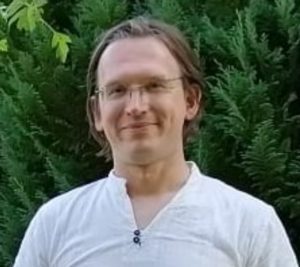 |
Ralf Bierig is assistant professor at the Department of Computer Science and an associate at the Hamilton Institute at Maynooth University in Ireland. His research surrounds the areas of human-computer interaction (including virtual reality) and information behaviour (including information retrieval). He developed and leads a one-year conversion programme in HCI and UX and teaches a range of HCI-related subjects at undergraduate and postgraduate levels. Most recently, he has co-published a book on Search Interface Design and Evaluation together with an international team. Ralf is interested in improving user interfaces for both work and pleasure, and to make computing (interfaces) generally more human-centred and gentle while also including newer technologies (like AR/VR). Mindful computing, as one of his research directions, promises a pathway to integrating technology with digital health. |
 |
Peter Mooney is an Assistant Professor of Computer Science at Maynooth University and an associate at the Hamilton Institute and Innovation Value Institute (IVI). Peter’s main area of research lies at the intersection of Computer Science and Geography with particular emphasis on applying computational models such as AI and machine learning to working with volunteered, user generated and citizen collected geospatial data. He is actively involved in research relating to user interfaces and user-centred interface design particularly focused to cartographic visualization and mapping. Peter is a passionate advocate and educator for the widespread use of open data, open science and open source software and has been actively involved with open source and open geodata communities globally for many years. Outside of academic pursuits Peter enjoys gardening, distance running and landscape photography. |
Free Registration
Please register via Eventbrite.
Schedule
|
Location and Venue
Venue: We meet at Maynooth University, North Campus, Iontas building (marked as (48) on this MU Campus Map.
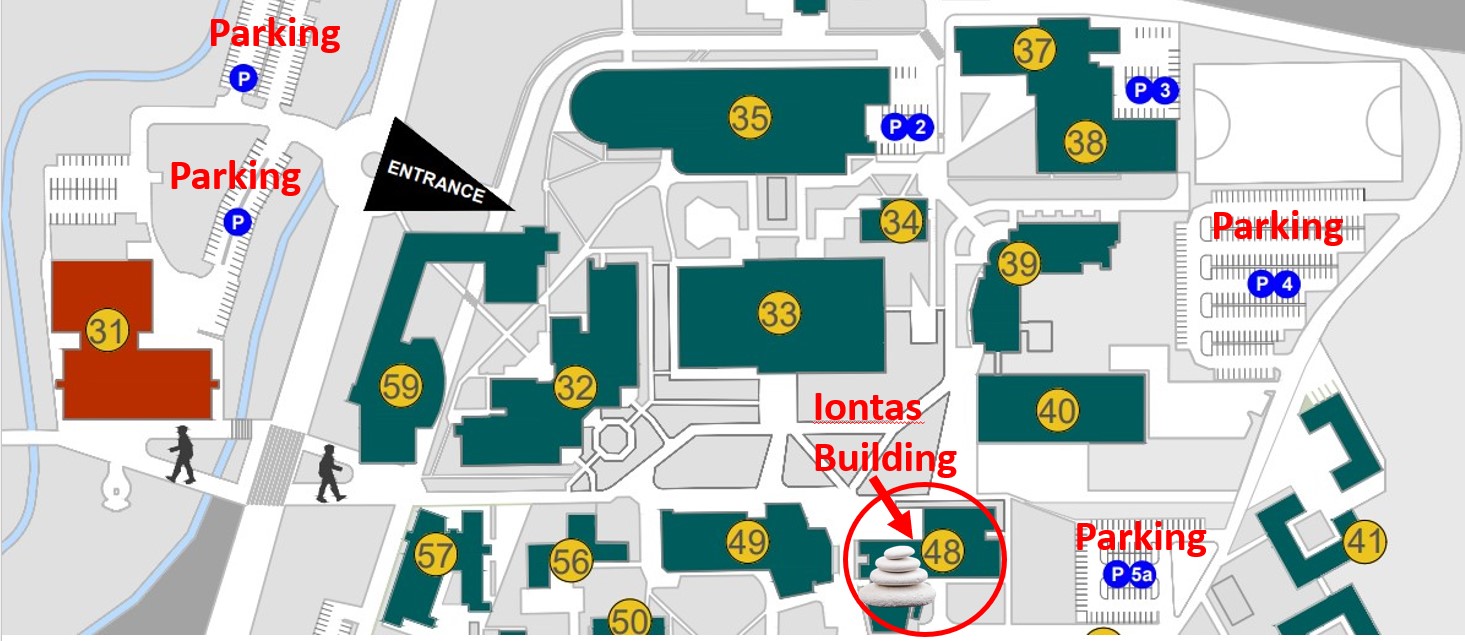
The EIRCODE of the Iontas Building is W23 NPY6 and its geographic coordinates are (Latitude, Longitude) 53.384627,-6.600426.
Or maybe, you just want to use Google Maps or OpenStreetMap to get you to the Iontas building.
Parking: The workshop is being held during ‘reading week’ or ‘mid-term break’. As a result the usual pressure on parking is greatly reduced. Some autumn graduation is taking place on the same day. You can park in any of the car parks around the North Campus, and very conveniently at those locations (highlighted in red) in the campus map picture above. Please be aware that any illegal or dangerous parking may result in clamping.
Rooms: The main room for the workshop will be Seminar Room 1.33 in the Iontas building (first floor). Access it by the stairs or the elevators (on the left after entering the building). An additional breakout room will be used during the day and we will tell you more about that then. Flyers and signs will guide you from the entrance to the room. Watch out for the pebbles!
Coffee/Lunch: Complimentary tea/coffee breaks and a lunch break are available to all participants. All breaks will be catered for at Room 1.33.
Wifi: The building has Eduroam WiFi and MUGuest (the public guest network). Visitors from other research institutions should be able to access Eduroam. If you do not use Eduroam, you can use our MUGuest network (through a simple web-based signup). We can help you on the day, when needed.
Sponsor
Support for this workshop is provided by MUSSI (Maynooth University Social Sciences Institute).
